Meat Grinder or Food Processor for Sausage?
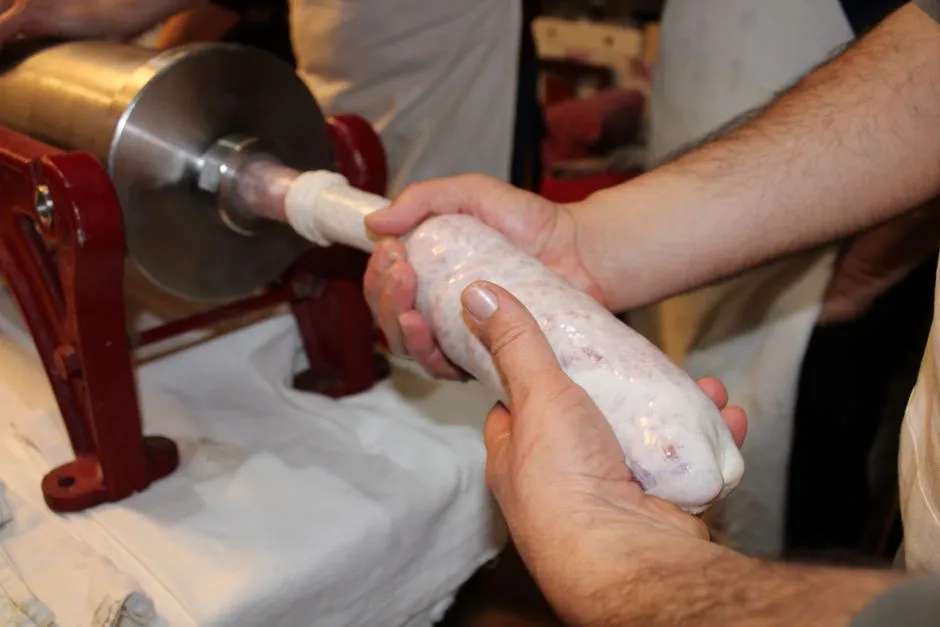
- Should you use a meat grinder or food processor for sausage?
- Compare the two tools by the job
- What a meat grinder controls
- What a food processor can and cannot replace
- Keep the meat cold through either machine
- Run one comparison batch before buying
- What to inspect before buying a grinder
- Clean and separate raw-meat equipment
- Cook the test safely
- Frequently asked questions
- Sources
Should you use a meat grinder or food processor for sausage?
Use a meat grinder when you want repeatable coarse or fine particles, larger batches, or a path toward stuffing links. Use a food processor when you already own one, are making a small fresh batch, and accept a finer, less uniform result. Oregon State University Extension recommends a grinder for home-ground sausage and says food processors have limited versatility because they produce a fine grind.
Neither choice changes raw-meat safety. Cold handling, cleaning, separation, and a thermometer remain essential.
Compare the two tools by the job
| Question | Meat grinder | Food processor |
|---|---|---|
| Particle control | Interchangeable plates make the target size repeatable | Pulse length, batch size, and blade path make the result less uniform |
| Batch size | Better suited to repeated or larger batches within the maker's duty limits | Best treated as a small-batch option within the appliance manual |
| Texture range | Coarse and fine plates provide distinct results | Oregon State describes the result as a fine grind |
| Link-making path | Some grinders accept a stuffing attachment | Does not replace a sausage stuffer |
| Equipment already owned | Requires a grinder or compatible attachment | May avoid a purchase for a first trial |
| Cleaning | Screw, knife, plate, tray, and feed parts all need cleaning | Bowl, blade, lid, and feed parts all need cleaning |
This is a desk-researched decision aid, not a product test. Check the exact manual for capacity, duty cycle, raw-meat use, cleaning, and parts.
What a meat grinder controls
The University of Connecticut Extension describes a grinder as a screw auger that moves meat through a knife and a perforated plate. Changing the plate changes the particle size. Its guide lists 1/4-, 3/8-, and 1/2-inch holes for coarse grinding, and 1/8- or 3/16-inch holes for fine grinding.
A selected plate makes particle size repeatable across batches.
Sharpness matters too. UConn warns that a dull knife-and-plate set creates excessive heat, which can render or melt fat and produce a smeared mixture. A grinder that pushes paste around the plate, warms rapidly, or requires unsafe force needs to stop. Unplug it, follow the manual's clearing and assembly procedure, and inspect the approved wear parts.
Some grinders accept stuffing horns, but a grinder is not automatically a good stuffer. Check the manual for the attachment, supported casing range, operating sequence, and duty limit. Our published guide to stuffing sausage casings covers the filling step separately.
What a food processor can and cannot replace
Oregon State's home-preservation guidance gives the food processor a narrow role: it can be used, but it produces a fine grind and offers less versatility than a grinder. That is the honest starting point for a home cook who already owns a processor.
For a first fresh batch, the editorial method is to cut cold meat and fat into pieces the manual permits, work in small equal batches, and use short pulses. Stop before the mixture becomes a smooth paste unless a validated recipe specifically requires an emulsified texture. Combine the processed batches only after each has reached a similar particle size.
Results still vary with bowl, blade, batch, and meat. If the manual does not approve raw meat, do not improvise. Unplug a stalled appliance before following its clearing instructions. Keep hands and utensils away from a connected blade.
A processor also does not create a casing-ready workflow by itself. Patties and loose sausage are the simpler endpoint. The site's one-kilogram breakfast sausage batch shows how a weighed fresh mixture can become patties without a stuffer.
Keep the meat cold through either machine
Mississippi State University Extension says sausage meat should stay cold throughout processing and calls for chilling it to approximately 32°F before grinding to limit fat smearing. Its safety section says to keep meat at 40°F or lower during grinding and mixing.
Treat those as process controls, not permission to leave meat on the counter until it happens to feel cold. Prepare the scale, seasonings, containers, and cleaned equipment before the meat leaves refrigeration. Divide a processor batch in advance so the waiting portion can remain cold. With a grinder, keep the receiving bowl ready and stop if the meat or equipment begins warming beyond the source's limit.
Do not use the freezer to disguise meat that has been held unsafely. Cold texture control and food safety overlap, but one does not erase the other.
Run one comparison batch before buying
If you own a processor, test it against a defined result before buying a grinder.
- Choose one tested fresh-sausage formula.
- Decide whether you need patties, loose sausage, or links.
- Name the target texture: coarse pieces, an even fine grind, or a cohesive mixture.
- Process a modest batch within the manual and cold-handling limits.
- Cook a test portion to its safe endpoint.
- Record texture, smearing, cleanup, and whether the form held.
If the processor produced the wanted fine texture, keep it. Choose a grinder for visible particles, repeatable plates, larger throughput, or a supported stuffing attachment.
What to inspect before buying a grinder
Start with the manual and parts diagram, not the marketing photograph. Check:
- the plate sizes supplied and the additional sizes actually available;
- whether the knife and plates are replaceable and can be installed in the documented orientation;
- the rated batch or duty limits and required cooling breaks;
- the feed tray, pusher, and guards supplied for safe operation;
- whether food-contact parts can be fully disassembled for cleaning;
- the maker's washing, sanitizing, drying, and storage instructions;
- whether a stuffing attachment is supported, if links are the goal;
- the warranty, parts availability, and repair route.
Do not buy by motor wattage alone. A published electrical number does not tell you plate condition, feed design, serviceability, or whether the machine suits your batch. Do not claim that a grinder can process bone, frozen blocks, or other hard material unless the exact manual explicitly permits it.
Clean and separate raw-meat equipment
Mississippi State University Extension says to use good hand-washing practices and thoroughly clean and sanitize utensils and equipment before use. Keep raw meat, its tools, and its juices away from ready-to-eat food.
Disassemble only as the appliance manual directs. Unplug powered equipment first. Clean crevices, plates, blades, bowls, lids, pushers, and receiving containers, then apply any sanitizing step specified by current food-safety guidance and the material's maker. Dry parts as directed before storage. Never reach into a feed opening or connected blade area to save a spoonful of mixture.
This article covers fresh, uncured sausage. It does not provide a curing, fermentation, preservation-smoking, or shelf-stable process. Those projects require validated formulas, precise controls, and specialist guidance.
Cook the test safely
Grinding spreads surface contamination through the mixture, so colour and texture cannot establish safety. FoodSafety.gov gives ground meat and sausage a 160°F (71°C) minimum and poultry sausage a 165°F (74°C) minimum. Measure with a food thermometer in the centre of the thickest test portion.
Refrigerate or freeze the remaining raw mixture promptly under the storage guidance for fresh sausage. Do not taste raw sausage and do not return a cooked-sample utensil to the uncooked mixture.
Frequently asked questions
Do I need a meat grinder to make sausage?
No. UConn Extension says the simplest route can begin with purchased ground meat, while Oregon State says a food processor can be used when a fine grind is acceptable. A grinder becomes useful when you need repeatable particle sizes, more throughput, or a supported route toward stuffing.
Will a food processor make coarse sausage?
Do not assume it will. Oregon State's home guidance describes food processors as limited because they produce a fine grind. Short pulses may leave some larger pieces, but the result is less controlled than selecting a grinder plate. Judge one safe test batch rather than promising a texture the appliance may not deliver.
What grinder plate should a beginner use?
Match the plate to a tested recipe and the texture you want. UConn lists 1/4-, 3/8-, and 1/2-inch holes as coarse options and 1/8- or 3/16-inch holes as fine options. Confirm that the plate fits the exact grinder and install it according to the manual.
What temperature should fresh sausage reach?
FoodSafety.gov gives ground meat and sausage a 160°F (71°C) minimum and poultry sausage a 165°F (74°C) minimum. Use a food thermometer; colour is not the endpoint.